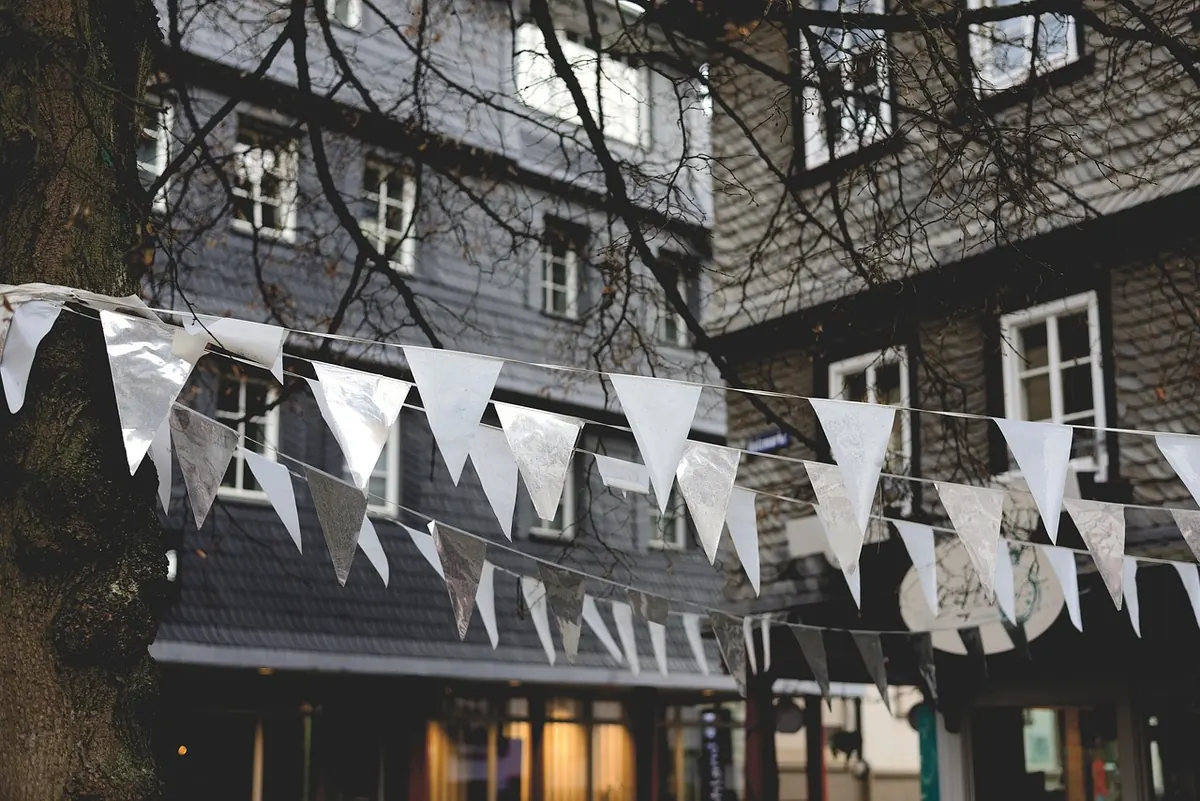
A bunting photo wall looks effortless in the finished pictures, which is exactly why it goes wrong so often. The flags are lovely, the flowers are lovely, and then the photos arrive with the bunting slicing through the top of everyone's head or a wash of purple light across the bride's face. Almost every one of those problems is decided before the first flag goes up. Here are the rules that matter, in the order you should think about them.
Before you choose a colour or a height, answer three questions. Where will the photographer stand? How wide is the shot — a couple at arm's length, or six people in a row? And is the backdrop being shot with flash or with ambient light in the room?
A phone held at chest height by a guest gives you a very different frame from a photographer's 50mm lens at three metres. The chest-height phone sees less sky and more wall, so a lower backdrop works. A wider group shot pulls in more of the room, so the bunting needs to be higher and wider to fill the corners. Measure the space with that in mind, not with your eye.
For standing portraits, the top of the backdrop fabric should sit around 2.4 metres, with the bunting string just beneath it at roughly 2.2 to 2.4 metres. That puts the lowest point of the flags a comfortable hand's width above the tallest guest's head while keeping everything inside the frame.
Two failure modes are common. String the bunting too high — say 2.8 metres and up — and you get a band of empty backdrop above every head, plus a string that disappears out of frame in tight shots. String it too low and the flags drop behind people's shoulders, where they read as clutter instead of decoration.
For seated tables or a low photo moment, come down to 1.8 to 2 metres and let the bunting sit behind the shoulders. If you are building a corner backdrop rather than a flat wall, keep it low enough that the two sides still show in a wide frame; corners photograph beautifully because they wrap around the group and block out the room behind.
Flag size should relate to the backdrop width, not to how many flags you happen to own. A workable rule: each triangle about one-eighth to one-tenth of the backdrop's width. On a 2.4-metre wall, that means flags roughly 15 to 20 centimetres wide.
Allow for sag. A natural drape of three to five centimetres per metre looks relaxed and intentional; more than that and the middle flags hang below head height. Tie off firmly at both ends and use two anchor points in the middle for anything over three metres.
The backdrop is there to set people off, not to compete with them. Mid-tone, muted and jewel colours — dusty rose, terracotta, sage, navy, mustard, plum — separate cleanly from skin and read well in both daylight and flash.
Three colours to handle carefully:
Build a palette of two or three core colours plus one neutral. If your venue has strong colour already — dark panelling, a coloured carpet — pick one backdrop shade that contrasts with it so the photo wall doesn't blur into the room. And check shine: satin, sequin and laminated backdrops throw hotspots under flash, so favour matte fabric, paper or a painted panel.
Layering is what turns a string of flags into a scene, and it works best in three planes. Plane one is the backdrop itself. Plane two is the bunting. Plane three is anything in front — a floral arch, a cluster of greenery, a couple of light strands.
With lights, warm white around 2700K gives the soft glow most people want. Keep fairy lights behind sheer fabric for a diffused wash, or run them along the bunting string itself if you want visible sparkle. Avoid mixing cool white and warm white in one frame; a camera can only white-balance for one, and the mismatch shows as a colour cast. If you must use both, keep the cool source away from faces.
With flowers, put the weight low. A floral garland along the top of the backdrop frames the shot; a heavy arrangement at eye level competes with the people you are photographing. For standing groups, keep floral mass at shoulder height or below, and let trailing foliage soften the corners. Greenery also hides the anchor points, which is the quiet reason it earns its place.
Ten minutes before the doors open, have someone stand in the spot where guests will pose. Take a photo with the same camera or phone that will be used, at the same distance, with the same flash setting. Then look for four things: the top of their head clear of the flags, no bright hotspot on the backdrop, no colour cast on their skin, and a frame that is mostly backdrop rather than ceiling or floor.
Adjust once, reshoot, and leave it alone. If something needs to change, the string height and the lighting are the two easiest fixes, and both take minutes. Do that check and the backdrop will do its job quietly all night — which is exactly what a good photo wall should do.
Photo: congerdesign / Pixabay