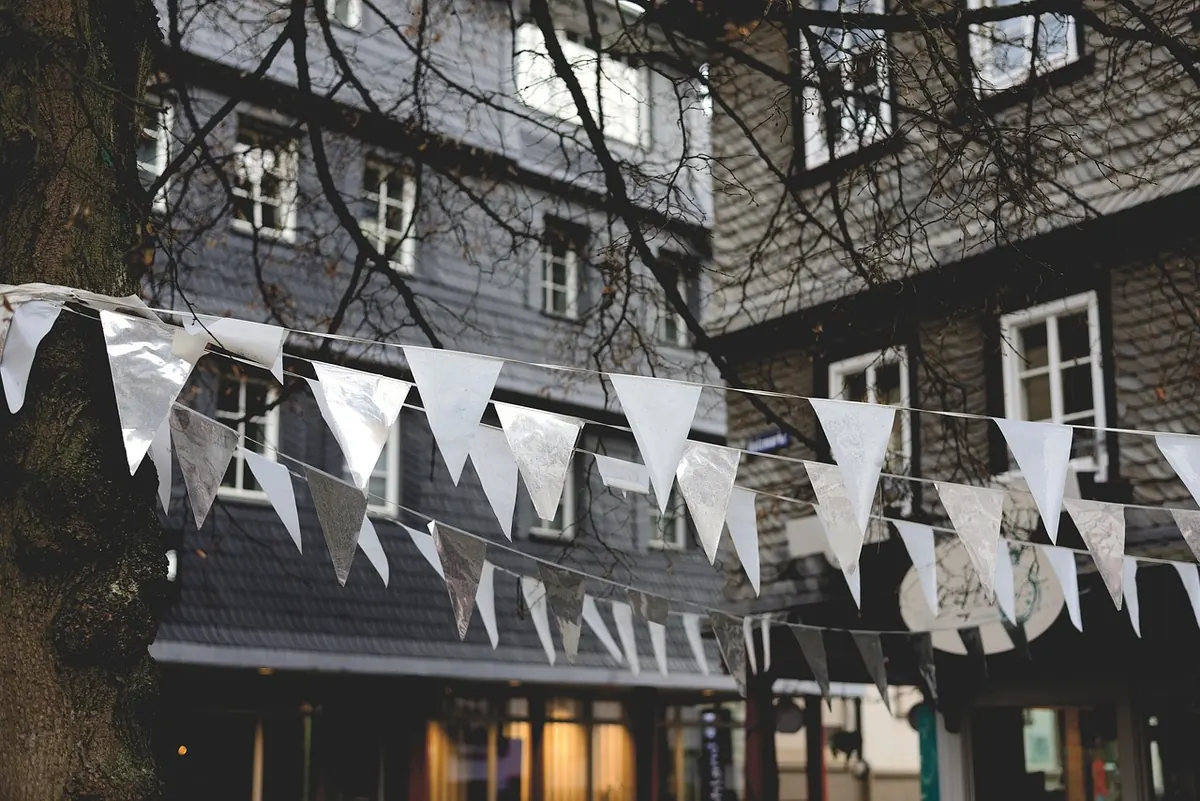
Christmas bunting is the rare decoration that looks generous but costs almost nothing. A string of triangles across a mantel, a felt "MERRY" above the table, a tartan swag running along the banister: it sets the tone for the whole room before anyone has opened a present. And because bunting is small, repetitive and forgiving, most designs can be finished in an afternoon, often while something is in the oven. Here are eight that hold up on the wall, along with honest notes on how hard each one is and how long it really takes.
Almost every design below follows the same logic, so it pays to set up properly once. Make one template from card: a triangle 20cm wide across the top and 25cm tall is the classic proportion. Slightly wider and shorter looks more modern; narrower and taller reads more traditional. Cut all your shapes from that template, and the bunting will look deliberate rather than improvised.
Two habits save hours. Press fabric before cutting, because creases become lopsided triangles. And cut with pinking shears if you are not sewing hems — the zigzag edge stops most cotton from fraying enough to matter for a season's display.
Difficulty: very easy. Time: 30–40 minutes for 2 metres.
Fold paper doilies in half over a length of string and glue the two halves together, alternating white doilies with plain red or green card triangles. This is the one to make with children at the kitchen table, and it is the only design here that you should not hang outdoors in the rain.
Difficulty: easy. Time: 45–60 minutes.
Draw simple outlines — a gingerbread man, a bauble, a star, a holly leaf — onto paper, pin to 2mm felt, and cut two of each. Sandwich a length of narrow ribbon between the layers and stitch around the edge with a blanket stitch in contrasting embroidery floss. Add a few French knots as buttons on the gingerbread men. Felt needs no hemming, so this is the tidiest option for anyone who does not own a machine.
Difficulty: easy. Time: 1 hour for nine flags.
Cut one triangle per letter of "MERRY" or "NOEL", then trace letters onto felt or iron-on interfacing and stitch or fuse them in place. Keep the lettering to one typeface and one colour; mixed fonts on bunting almost always look muddled. If your string is long enough, spell the whole greeting, or use a single word per room.
Difficulty: easy, needs a machine. Time: 1.5–2 hours for 3 metres.
Cut 15–20 triangles, then sew them right sides together in pairs, turn, and press — or simply fold the top edge over the tape and stitch through. Choose a mix of two or three prints plus one solid, and repeat them in a set order rather than randomly. Leave a 4cm gap between triangles so the bunting drapes instead of bunching.
Difficulty: easy to moderate. Time: 2 hours.
Flannel and brushed tartan fray more than cotton, so these triangles want a proper seam. Sew a strip of ric-rac or velvet ribbon along the bottom edge of each triangle before attaching it to the tape. Because the fabric is heavier, use wider twill tape and stitch slowly. This is the design that looks best on a staircase or above a fireplace, where the weight helps it hang straight.
Difficulty: moderate. Time: 2–2.5 hours.
Felted wool jumpers — ones that have already been shrunk in a hot wash — cut cleanly and do not fray. Cut triangles from the body panels, mix cable knits with plain ones, and leave the ribbed cuffs as little hanging strips between flags. Wool is heavy, so shorten the gaps to 3cm and use a sturdy tape. This one suits a rustic or cabin-style tree and feels genuinely different from shop-bought paper flags.
The difference between homemade and handmade comes down to three small things. Trim the tape ends neatly and fold a small loop at each end for hanging. Space the flags evenly — measure once with a ruler and mark the tape with a pencil before you pin anything. And press the whole length when you have finished, which flattens the tape and makes the triangles sit at the same angle.
If a design takes longer than an evening, simplify it. Bunting is meant to be cheerful, not a second job.
Roughly, allow 12cm of tape per triangle plus its gap, then add 30cm at each end for tying. That works out at about 2.5 metres of finished bunting for every metre you want to cover, because swags drape rather than lie flat. Measure the mantel, the window, or the doorway, then divide by two for the number of triangles. When in doubt, make more than you need: leftover bunting can loop around a mirror or drape across a shelf.
Use adhesive hooks sized for the weight of the fabric, or small cup hooks on woodwork where you are happy to make a hole. Keep bunting away from candles, hot fairy bulbs and open fires, and bring fabric designs indoors in wet weather unless you have used a synthetic fabric that dries quickly. Take the bunting down before the decorations come out in January, press it lightly, and roll it around a cardboard tube rather than folding it; the flags will hang flat the following December without any work at all.
Photo: sashamatic / Pixabay