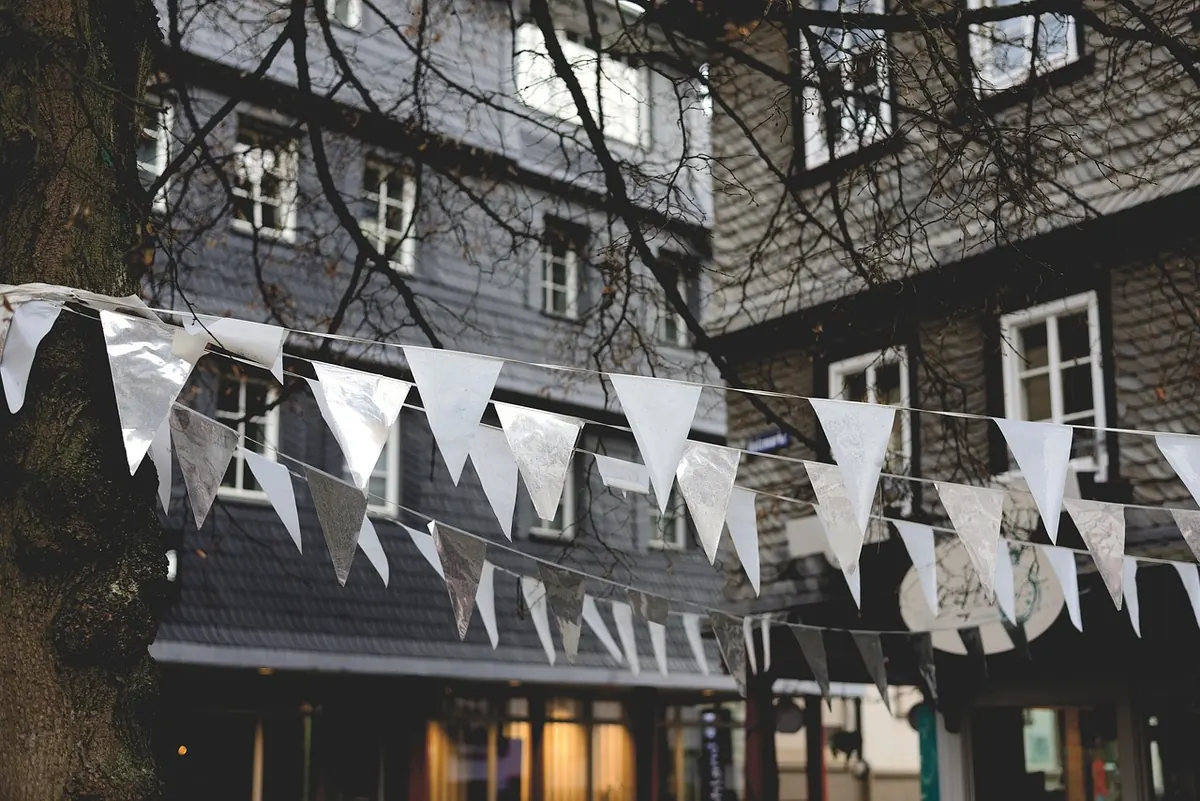
Bunting looks like the easiest sewing project in the world until you hold the finished string up against a wall and notice that one flag is noticeably wider, the tape is curling into a corkscrew, and the whole run sags in the middle like a clothesline after rain. None of that means you did something wrong. It means you hit one of the seven snags almost everyone hits the first few times.
The good news is that each one has a fix you can do in minutes, often without unpicking the whole thing.
Cutting freehand, one flag at a time, is the biggest single source of lumpy bunting. By flag four your hand has drifted, and by flag twelve you have something that looks like it was cut with scissors and hope.
Cut one template from card, template plastic or a flattened cereal box, and use it every single time. Trace around it with chalk or a soft pencil on the wrong side of the fabric, then stack four or five traced shapes and cut through the pile with a rotary cutter and ruler. Batch cutting stops the layers shifting and gives you flags that are genuinely identical.
If your triangles are already cut and uneven, trim the whole set down to the smallest one and use the offcuts as a test strip before you sew. If losing that much fabric hurts, keep the shorter flags for the two ends of the string, where the eye reads them last.
The fix: one template, several layers, one cut.
Quilting cotton frays cheerfully. Felt, oilcloth and laminated fabrics mostly don't. If you cut thirty cotton triangles and left them in a bag for a week, you'll find a snowdrift of threads at the bottom and flags that have lost their sharp points.
The tidiest solution is to sew two triangles right sides together, leave a small gap, turn them out and press. All the raw edges end up hidden inside, and the double layer gives the flag enough body to hang properly instead of curling. If you've already cut single-layer flags, run a narrow zigzag stitch along each raw edge, or apply a thin line of fray-check or fabric glue. Test the glue on a scrap first, because some brands stiffen the fabric or leave a visible line.
A pair of pinking shears is a quick, low-effort backup, but the zigzag edge is still a raw edge. It slows fraying rather than stopping it.
Uneven gaps are more obvious than uneven flags. The eye picks up a rhythm instantly, and one crowded pair of flags will bother you every time you look at the photos.
Don't guess the spacing. Work it out once and mark it before you sew anything:
If it's already sewn and one gap is off, unpick only that flag's section of seam and reposition it. On a long run, you can also disguise a wide gap by placing it where a door frame, post or window mullion will break the line anyway.
The flags get all the attention and the tape gets whatever is in the drawer. That's how you end up with a beautiful set of floral triangles strung on narrow satin ribbon that slides, twists and refuses to hold a knot.
Choose a binding that's at least 2 cm wide and in a colour that either ties into the print or sits quietly neutral: white, cream, natural, or a shade pulled directly from the fabric. Double-fold bias binding is the easiest option because the fold does the work of hiding the raw top edges of your flags. For outdoor bunting, go for cotton webbing, twill tape or a woven ribbon rather than satin, which is slippery and stretches.
Two more things worth remembering. Allow around 40 to 50 cm of extra tape at each end for tying, and pre-wash or pre-shrink ribbon and tape if there's any chance it will shrink later. Shrunken tape on unshrunk fabric is a recipe for puckers.
Indoor bunting and outdoor bunting are different jobs. Quilting cotton will fade in strong sun and can go musty or mildewed if it's left out through damp weather. If the string is going up in a garden and staying there, use oilcloth, laminated cotton, outdoor canvas or a synthetic that can handle a shower.
If you'd rather use your favourite cotton, treat the bunting as a party guest: put it up for the day and bring it in afterwards. Pre-washing the fabric also removes the sizing and any shrinkage, so the flags stay flat and true when they're pressed.
Weight adds up fast. Thirty cotton flags on a single line of thin tape will sag between the fixing points no matter how neatly you've sewn them, and wind will turn a loose string into a tangled mess in minutes.
Plan the hanging points before you sew. For a long run, use three or four attachment points instead of two, and consider sewing a second row of stitching along the tape for extra strength. Outdoors, use clips, zip ties or hooks rather than drawing pins, and leave a little slack so a gust has somewhere to go. A short string is almost always easier to hang well than a very long one, so if you need a long run, make it in two or three sections.
Pressing is what separates bunting that looks bought from bunting that looks made. Press each seam as you go, trim your thread ends as you finish each flag, and clip the point of a triangle before turning it right side out so the tip comes out clean. A chopstick or the blunt end of a paintbrush pushes that point out neatly.
Then do the thing almost nobody does: hang the finished string up at home, in daylight, before the event. Ten minutes with it on the wall will show you a twisted flag, a sagging section or a gap that needs adjusting while you still have time to fix it.
Before the bunting goes up, run through this:
None of these fixes take long. A little measuring, a template and a proper press will get you bunting that looks deliberate rather than improvised, and it will still be reusable for the next occasion.
Photo: Berna / Pexels